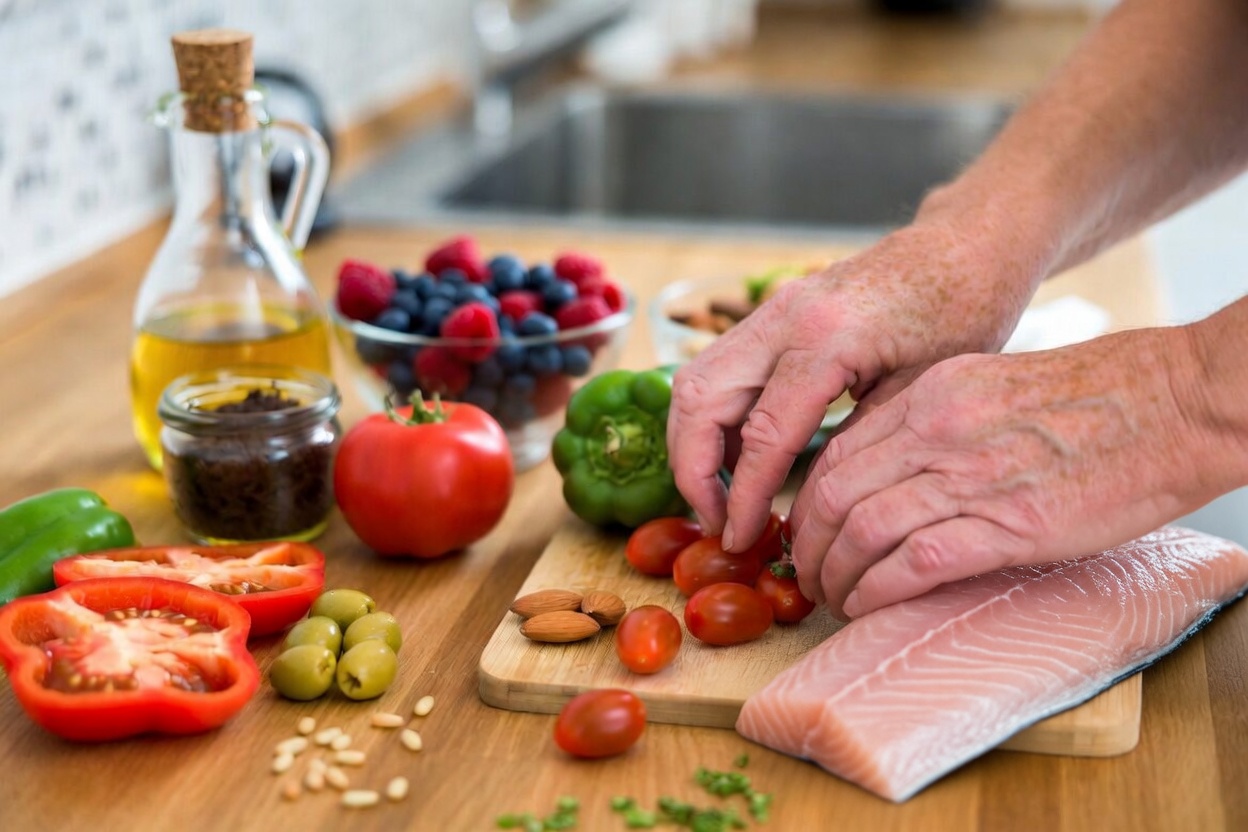
Nutrition and Brain Health: The MIND Diet and What the Research Says
A comprehensive guide to the MIND diet, brain-healthy foods, and what science actually shows about eating to reduce dementia risk.
The short version
1The MIND diet is associated with up to 53% lower Alzheimer's rates — even moderate adherence showed 35% reduction.
2Focus on: leafy greens daily, berries 2x/week, fish weekly, nuts most days, olive oil as primary fat.
3Limit: processed foods, sugar, red meat, fried food, butter. You don't need to eliminate them — just reduce.
4Food patterns matter more than any single food. Consistency over months and years is what the research supports.
What you eat affects your brain — and the evidence is more specific than "eat healthy." A 2015 study from Rush University found that people who closely followed the MIND diet had a 53% lower rate of Alzheimer's disease compared to those who didn't. Even moderate adherence was associated with a 35% reduction.
53%
lower Alzheimer's rates with high MIND diet adherence
Morris et al., 2015 — Alzheimer's & Dementia
The MIND diet — short for Mediterranean-DASH Intervention for Neurodegenerative Delay — was designed specifically for brain health. It combines elements of the Mediterranean diet and the DASH diet, focusing on the foods most consistently linked to cognitive protection. This guide explains what the MIND diet includes, what the science behind it actually shows, and how to start eating this way without overhauling your entire kitchen.
The 10 brain-healthy food groups
The MIND diet emphasizes 10 food groups shown to benefit brain health. Here are the most impactful ones, with the research behind each.
LG
Leafy green vegetables
6+ servings per week
The strongest evidence of any single food category. Women who ate the most leafy greens had cognitive abilities equivalent to someone 1–2 years younger (Morris et al., 2018).
B
Berries
2+ servings per week
Rich in flavonoids linked to slower cognitive decline. Blueberries and strawberries have the strongest evidence (Devore et al., 2012).
FF
Fatty fish
1+ serving per week
DHA makes up ~40% of brain polyunsaturated fats. Salmon, sardines, mackerel, trout. Even once weekly is associated with benefit.
N
Nuts
5+ servings per week
Rich in vitamin E, healthy fats, and plant protein. Walnuts are particularly well-studied for brain benefits.
OO
Olive oil
Primary cooking oil
Extra virgin olive oil contains oleocanthal with anti-inflammatory properties. The PREDIMED trial linked it to better cognitive outcomes.
WG
Whole grains
3+ servings per day
Provide steady glucose to the brain. Rich in fiber, B vitamins, and antioxidants. Oats, brown rice, quinoa, whole wheat.
BL
Beans & legumes
3+ servings per week
High in fiber, folate, and complex carbs. Support gut health and stable blood sugar — both relevant to brain health.
P
Poultry
2+ servings per week
Lean protein source. Chicken and turkey as alternatives to red meat.
Start here
If you change nothing else, add one serving of leafy greens per day and berries twice per week. These two changes alone align you with the strongest dietary evidence for brain health.
The 5 food groups to limit
The MIND diet doesn't just add good foods — it limits foods associated with inflammation, vascular damage, and metabolic disruption.
Red meat
Associated with increased inflammation
Fewer than 4 servings/week
Butter & margarine
Replace with olive oil
Less than 1 tbsp/day
Cheese
Full-fat cheese in particular
Less than 1 serving/week
Pastries & sweets
Includes cookies, cakes, candy, ice cream
Fewer than 5 servings/week
Fried & fast food
Unhealthy fats, excess calories, low nutrition
Less than 1 serving/week
What does the science actually show?
The original Morris study (2015)
The study that put the MIND diet on the map followed 923 adults aged 58–98 for an average of 4.5 years. Those with the highest MIND diet adherence had a 53% lower rate of Alzheimer's. Even the middle third saw a 35% reduction — meaning even partial adherence was associated with meaningful benefit.
Key takeaway
This was an observational study — it shows association, not causation. But the effect size was unusually large, and the researchers controlled for age, sex, education, physical activity, and smoking.
MIND vs. Mediterranean vs. DASH
35%
lower Alzheimer's risk even with moderate MIND diet adherence
Morris et al., 2015
The same study compared all three diets. The MIND diet showed the strongest association with reduced Alzheimer's risk, and moderate adherence to the MIND diet was more protective than moderate adherence to either Mediterranean or DASH. This matters practically — most people don't follow any diet perfectly.
The 2023 MIND Trial — honest context
Important context
A large randomized controlled trial (Barnes et al., 2023) found more modest results than the observational studies. Both the MIND diet group and control group improved, without a statistically significant difference between them. This doesn't erase the earlier evidence, but it suggests the benefits may be smaller than 53% or take longer to emerge. The scientific consensus: "promising" rather than "proven."
How diet affects your brain
What about supplements?
The evidence for brain health supplements is substantially weaker than for dietary patterns.
Food first
Omega-3 supplements have mixed results. Vitamin E, B12, and folate are important but supplementation hasn't consistently shown benefits in people who aren't deficient. Turmeric/curcumin has limited human evidence. Get these nutrients through whole foods — the MIND diet provides them all. If you're concerned about specific deficiencies, talk to your doctor about testing.
Getting started: practical steps
Week 1: Add, don't subtract
Don't start by eliminating foods. Start by adding one serving of leafy greens per day and berries twice this week. Buy extra virgin olive oil if you don't have it.
Week 2: The swap
Replace one red meat meal with fish or poultry. Replace butter with olive oil for cooking. Swap one processed snack for nuts.
Week 3: Build the habit
Add beans or lentils to two meals (soups, salads, grain bowls). Aim for whole grains at most meals.
Month 2+: Sustain and refine
By now you should be eating leafy greens daily, berries regularly, fish weekly, and nuts most days. Start reducing the "limit" foods gradually. The goal is a sustainable pattern, not perfection.
The MIND diet is not a cure or guarantee. The research shows associations with reduced risk, not certainties. Diet is one of 14 modifiable risk factors — an important one, but not the only one. The FINGER Trial showed that combining dietary changes with exercise, cognitive training, and vascular risk management produced the best outcomes.
How does your nutrition stack up across all 14 risk factors?
Diet is one piece of the picture. Take the Brain Health Quiz to see your personalized profile across all five domains — Move, Nourish, Sharpen, Connect, and Rest.
The MIND diet is the most evidence-backed dietary approach specifically designed for brain health. It emphasizes leafy greens, berries, nuts, fish, whole grains, and olive oil while limiting processed foods, sugar, and red meat. Even moderate adherence is associated with meaningful cognitive benefit.
You don't need to follow it perfectly. Start with leafy greens every day and berries twice a week. Build from there. The research suggests that every step toward this dietary pattern is a step toward protecting your brain — and unlike many things in health, eating well is something you can start doing today.
Sources
1. Morris, M.C., et al. (2015). MIND diet associated with reduced incidence of Alzheimer's disease. Alzheimer's & Dementia, 11(9), 1007–1014.
2. Morris, M.C., et al. (2018). Nutrients and bioactives in green leafy vegetables and cognitive decline. Neurology, 90(3), e214–e222.
3. Devore, E.E., et al. (2012). Dietary intakes of berries and flavonoids in relation to cognitive decline. Annals of Neurology, 72(1), 135–143.
4. Valls-Pedret, C., et al. (2015). Mediterranean diet and age-related cognitive decline. JAMA Internal Medicine, 175(7), 1094–1103.
5. Barnes, L.L., et al. (2023). Trial of the MIND diet for prevention of cognitive decline. New England Journal of Medicine, 389, 602–611.
6. Féart, C., et al. (2009). Adherence to a Mediterranean diet, cognitive decline, and risk of dementia. JAMA, 302(6), 638–648.
7. Singh, B., et al. (2014). Association of Mediterranean diet with mild cognitive impairment and Alzheimer's disease. Journal of Alzheimer's Disease, 39(2), 271–282.
8. Livingston, G., et al. (2024). Dementia prevention, intervention, and care: 2024 report. The Lancet, 404(10452), 572–628.
Medical disclaimer: This content is for educational purposes and is not medical advice. Consult a healthcare professional or registered dietitian before making significant changes to your diet.
Last reviewed: May 2026
This site uses cookies for analytics to understand how visitors engage with our content.
Privacy policy