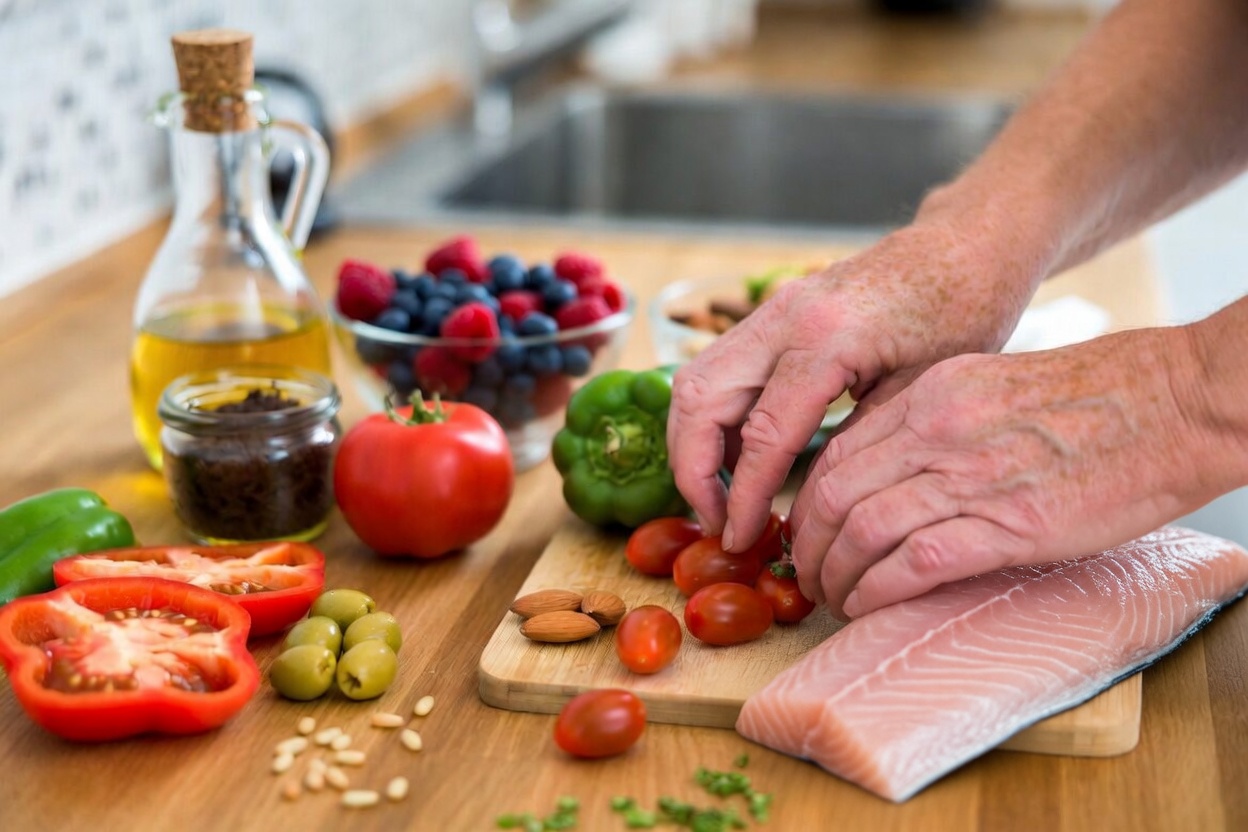
What to buy, what to limit, and why — based on the MIND diet and the research behind it.
Last reviewed: May 2026
Key takeaways
+The MIND diet identifies 8 food categories to prioritise and 5 to limit — this list maps both.
+Leafy greens have the strongest evidence of any single food: one daily serving was associated with cognitive function equivalent to being 11 years younger (Morris et al., 2018).
+No single food prevents dementia. The benefit comes from the overall pattern — more of the foods below, less of the ones to limit.
+Small, consistent substitutions are more effective than overhauling your kitchen at once.
The MIND diet — developed specifically for brain health by nutritional epidemiologist Martha Clare Morris and her team at Rush University — is not a list of superfoods. It's a dietary pattern: a consistent way of eating that has been associated with slower cognitive decline in multiple large observational studies.
This grocery list translates that pattern into what you actually put in your basket. Eight categories to prioritise, five to limit, and the research behind each one.
A note on evidence
The associations between diet and brain health come primarily from observational studies — they show correlation, not causation. A 2023 clinical trial found both a MIND diet group and a healthy control group improved cognitively, with no significant difference between them. The overall body of research still supports these dietary patterns as part of a brain-healthy lifestyle, but no diet has been proven to prevent dementia.
Part 1: Foods to prioritise
These eight categories form the core of the MIND diet. You don't need to eat all of them every day — the goal is to make them your defaults rather than your exceptions.
11 years
Younger in cognitive age for those eating the most leafy greens vs. the least
Morris et al., 2018 — Neurology (n=960, 5-year follow-up)
Richest evidence of any single food category. Morris et al. (2018, Neurology) found daily leafy green consumption was associated with cognitive function equivalent to being 11 years younger.
High in flavonoids and anthocyanins that may reduce inflammation and oxidative stress. The MIND diet specifically recommends berries over other fruit categories.
Target:At least ½ cup, twice a week
FS
Fatty fish
Salmon, mackerel, sardines, trout, herring
Rich in omega-3 fatty acids (EPA and DHA), which are structural components of brain cell membranes and associated with reduced neuroinflammation.
Walnuts in particular are rich in alpha-linolenic acid (ALA), a plant-based omega-3. Regular nut consumption is associated with better memory performance in older adults.
Target:A small handful (about 30g), most days
OO
Olive oil
Extra virgin olive oil (EVOO)
The primary fat source in both the Mediterranean and MIND diets. Rich in oleocanthal, a compound with anti-inflammatory properties, and monounsaturated fats associated with cardiovascular and brain health.
Target:Use as your primary cooking and dressing fat
WG
Whole grains
Oats, brown rice, quinoa, barley, wholegrain bread and pasta
Provide steady glucose for brain energy without the blood sugar spikes associated with refined carbohydrates. Higher whole grain intake is linked to better vascular health, which directly affects the brain.
Target:3 or more servings daily
LB
Legumes
Lentils, chickpeas, black beans, kidney beans, edamame
High in fibre, folate, and plant protein. Support stable blood sugar levels and gut health, both of which are linked to cognitive function through the gut-brain axis.
Target:At least 4 meals a week
PT
Poultry
Chicken, turkey (skinless)
Lean protein source that provides B vitamins (particularly B6 and B12) essential for brain function and homocysteine regulation. A regular source of lean protein supports overall vascular health.
Target:At least twice a week
Where to start
If this feels overwhelming, start with two changes: add a daily serving of leafy greens and switch your cooking fat to extra virgin olive oil. These two alone move you meaningfully toward the MIND diet pattern and have the strongest individual evidence bases.
Part 2: Foods to limit
The MIND diet is not about elimination. It's about frequency. The five categories below are associated with increased cardiovascular and inflammatory risk — both of which affect the brain. The goal is to make them occasional rather than routine.
RM
Red & processed meat
High in saturated fat, which is associated with increased LDL cholesterol — a Lancet Commission risk factor. The MIND diet recommends fewer than 4 servings a week.
→Instead: Replace with poultry, fish, or legumes in most meals.
BS
Butter & margarine
High in saturated and trans fats linked to cardiovascular risk. The MIND diet recommends less than 1 tablespoon daily.
→Instead: Use extra virgin olive oil for cooking and as a spread.
CH
Cheese
A significant source of saturated fat. The MIND diet recommends limiting to once a week or less — not eliminating it entirely.
→Instead: Use as a flavour accent rather than a main ingredient.
FF
Fried & fast food
Associated with increased inflammation and cardiovascular risk factors. The MIND diet recommends fewer than once a week.
→Instead: Air-frying, baking, or grilling delivers similar textures without the inflammatory oils.
SW
Sweets & pastries
High in refined sugar and saturated fat. Frequent consumption is associated with blood sugar dysregulation, which is linked to increased dementia risk through multiple pathways.
→Instead: Berries with a small amount of dark chocolate (70%+ cocoa) satisfies the same craving with antioxidant benefit.
The pattern matters more than any single food
You don't need to give up red meat or cheese entirely. Research suggests it's the overall dietary pattern that matters — people who scored highest on MIND diet adherence ate these foods infrequently, not never. One burger or a piece of cheese is not the issue. The issue is when these foods become the baseline and the brain-healthy foods become the occasional treat.
Your printable grocery list
Use this as a starting framework. You don't need every item — pick the ones that fit how you already eat and build from there.
Produce
Spinach or kale (bag or bunch)
Rocket / mixed greens
Broccoli or courgette
Carrots or sweet potato
Blueberries (fresh or frozen)
Strawberries
Tomatoes
Protein & fats
Salmon fillet or tinned sardines
Chicken breast or thighs
Walnuts (small bag)
Almonds
Eggs
Extra virgin olive oil
Grains & legumes
Rolled oats
Brown rice or quinoa
Wholegrain bread
Tinned chickpeas
Tinned lentils or black beans
Wholegrain pasta
Pantry
Dark chocolate (70%+ cocoa)
Green or herbal tea
Balsamic or red wine vinegar
Garlic
Turmeric
Flaxseed or chia seeds
How diet fits into the bigger picture
Nutrition is one of five domains linked to brain health in the research. It addresses several of the modifiable risk factors identified by the 2024 Lancet Commission — particularly obesity, diabetes, and high LDL cholesterol — but diet alone doesn't capture the full picture.
The FINGER trial, which is the scientific basis for the multi-domain approach, combined diet with exercise, cognitive training, and vascular monitoring. Each domain contributed independently, and the combination was more effective than any single change on its own.
The Brain Health Quiz covers nutrition and all four other domains linked to dementia risk. Takes about 5 minutes and gives you a personalised action plan.
Morris MC, et al. (2018). Nutrients and bioactives in green leafy vegetables and cognitive decline: Prospective study. PubMed →
Morris MC, et al. (2015). MIND diet associated with reduced incidence of Alzheimer's disease. Alzheimer's & Dementia. PubMed →
Barnes LL, et al. (2023). Trial of the MIND Diet for Prevention of Cognitive Decline in Older Persons at Risk. New England Journal of Medicine. PubMed →
Livingston G, et al. (2024). Dementia prevention, intervention, and care: 2024 report of the Lancet standing Commission. PubMed →
Ngandu T, et al. (2015). A 2-year multidomain intervention of diet, exercise, cognitive training, and vascular risk monitoring versus control to prevent cognitive decline in at-risk elderly people (FINGER). Lancet. PubMed →
This content is for educational purposes and is not medical advice. Consult a healthcare professional before making changes to your health routine. Last reviewed: May 2026.
This site uses cookies for analytics to understand how visitors engage with our content.
Privacy policy