Best Brain Exercises for Seniors: What Actually Works
The research-backed activities that build cognitive reserve, strengthen memory, and may help protect against dementia — ranked by evidence.
Key takeaways
+Not all brain exercises are equal. The key factor is novelty and challenge — doing hard, unfamiliar things — not repeating activities you're already good at.
+Learning new skills (languages, instruments, photography) has the strongest evidence for building cognitive reserve in older adults.
+Brain training apps may improve the specific tasks they test, but evidence for broader cognitive benefits is limited and contested.
+Physical exercise and social engagement are brain exercises too — and may be more protective than puzzles alone.
The best brain exercise for seniors is not a crossword puzzle. It's not Sudoku, and it's probably not the brain training app you've seen advertised. Those activities are fine — enjoyable and mentally engaging — but the research consistently points to something different when it comes to genuinely protecting cognitive function as you age.
The activities with the strongest evidence share one quality: they require you to struggle with something unfamiliar. Learning, not just doing. Novelty, not routine. That distinction changes what's worth your time.
This guide walks through the brain exercises that have actual research support, ranked by the strength of evidence, so you can make informed decisions about where to invest your time and energy.
~16 hrs/week
Time spent learning new skills in the Synapse Project
Participants who did this for 3 months showed measurable memory improvement (Park et al., 2014)
SH
The key principle: challenge, not comfort
Before we get to specific activities, it's important to understand why some brain exercises work better than others. The concept that explains this is cognitive reserve — your brain's accumulated ability to compensate for age-related changes and even early signs of neurodegeneration.
Cognitive reserve is built through years of complex mental engagement. Think of it as the difference between a well-connected road network with many alternate routes, and a single highway. When one path is blocked (by age-related changes or disease), a brain with more reserve has more alternative routes available.
The critical finding from the research is that building cognitive reserve requires activities that genuinely challenge you — activities that engage working memory, problem-solving, and sustained attention simultaneously. Comfortable, familiar activities maintain what you have, but they don't build new capacity.
TK
The core rule
If an activity feels easy and comfortable, it's maintenance. If it feels effortful and slightly frustrating — the struggle of learning something new — that's when your brain is building new connections. Aim for the second category.
SH
The best brain exercises, ranked by evidence
Not all cognitive activities are supported equally by research. Here are the major categories, ordered from strongest to weakest evidence for protecting cognitive function in older adults.
Tier 1: Strong evidence
LN
Learning a new language
Even 20–30 min/day shows benefits
Strong
Bilingualism is associated with delayed onset of dementia symptoms by approximately 4–5 years (Craik et al., 2010). Starting a new language in later life engages executive function, working memory, and cognitive control simultaneously. Multiple studies suggest language learning in older adults is associated with improved attentional switching, inhibition, and working memory — with corresponding changes visible on brain imaging.
MU
Learning a musical instrument
Regular practice, even at beginner level
Strong
Music training engages auditory processing, motor coordination, memory, and attention simultaneously — more brain systems than almost any other single activity. A study found that 6 months of piano lessons improved executive function and processing speed in older adults (Bugos et al., 2007). Even group music-making (drumming, singing) has been associated with cognitive benefits in people with early cognitive decline.
NS
Learning other complex new skills
Photography, quilting, coding, art, etc.
Strong
The Synapse Project (Park et al., 2014) demonstrated that learning demanding new skills like digital photography and quilting — 16 hours per week for 3 months — improved episodic memory in older adults. The key is that the skill must be genuinely novel and challenging. Familiar crafts or hobbies you've done for years don't produce the same benefit.
Tier 2: Moderate evidence
ST
Strategic games
Chess, bridge, Go, strategy board games
Moderate
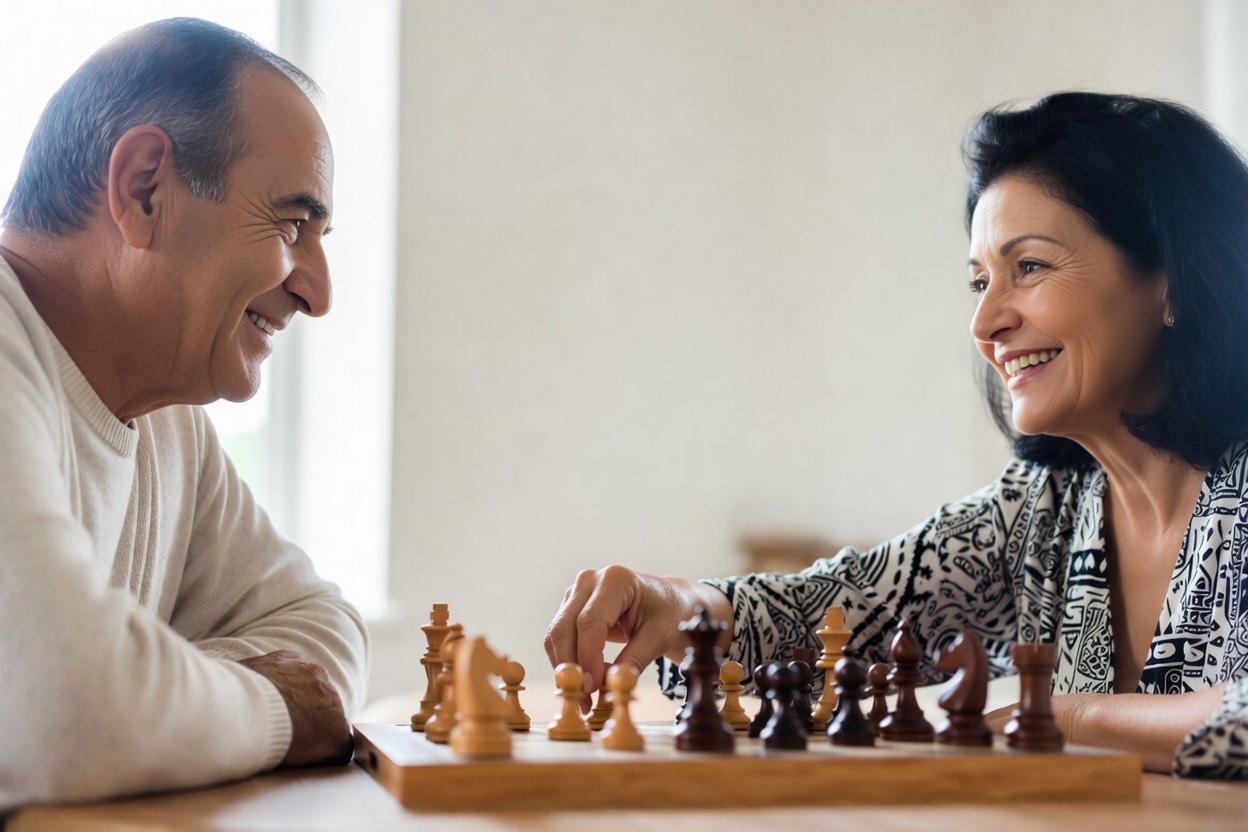
Games requiring planning, strategic thinking, and adapting to opponents engage executive function and working memory. Several observational studies associate regular game-playing in older adults with lower rates of cognitive decline. The social component of playing with others may provide additional benefit. However, most evidence is observational, not from controlled trials.
RD
Reading and writing
Especially material outside your comfort zone
Moderate
Regular reading is associated with better cognitive function in older adults, particularly when the material is challenging or introduces new concepts. Writing — journaling, creative writing, memoir — engages language production, memory retrieval, and organization. A structured reading-writing-math program (StrongerMemory) showed cognitive improvements targeting the prefrontal cortex.
ED
Formal education and courses
Community college, online courses, lectures
Moderate
Less education earlier in life is one of the 14 Lancet Commission risk factors for dementia. Continuing education in later life appears to build cognitive reserve through structured learning, social interaction, and intellectual challenge. Online platforms have made this more accessible than ever.
Tier 3: Limited or mixed evidence
PZ
Puzzles (crosswords, Sudoku, jigsaw)
Enjoyable but limited transfer
Emerging
Crosswords and Sudoku are among the most popular brain exercises — but the evidence for broad cognitive protection is weaker than many people assume. These activities improve performance on the specific tasks themselves (you get better at crosswords), but evidence for transfer to general memory, attention, or dementia risk is limited. They're better than passive activities like watching TV, but less effective than learning genuinely new skills.
BT
Brain training apps
Lumosity, BrainHQ, Peak, etc.
Emerging
Computerized brain training is one of the most studied — and most debated — areas in cognitive aging research. A 2025 McGill study found that BrainHQ training for 10 weeks restored cholinergic function in older adults. However, the broader field shows mixed results: many studies find that brain training improves performance on the trained tasks without clearly transferring to everyday cognitive abilities. The FTC fined Lumosity $2M for overstating its claims.
NT
Beware of marketing claims
Many brain training companies use persuasive marketing that goes beyond what the research supports. Phrases like "clinically proven to prevent cognitive decline" or "designed by neuroscientists" are often misleading. Look for specific published studies, not vague appeals to science. The fact that a product is developed by a neuroscientist does not mean it's proven to work.
SH
The exercises people forget: physical activity and social connection
When people think about brain exercises, they usually think about mental activities. But the research is clear that two other categories of "exercise" may be even more important for brain health.
Physical exercise has a stronger evidence base for brain protection than any cognitive activity. Aerobic exercise increases hippocampal volume, boosts BDNF (a protein that supports neuron growth), improves cerebral blood flow, and reduces inflammation. A year of moderate walking increased hippocampal volume by roughly 2% in older adults (Erickson et al., 2011). If you only do one thing for your brain, make it physical activity — then add cognitive challenges on top.
Social engagement provides cognitive stimulation that's hard to replicate with solo activities. Real-time conversation requires processing language, emotional cues, memory retrieval, and perspective-taking simultaneously. Social isolation is one of the 14 Lancet Commission risk factors for dementia. Group activities — a book club, a class, a walking group — combine social engagement with cognitive challenge, hitting both targets at once.
TP
The best combination
The most protective routine isn't any single activity — it's a combination. Physical exercise for the brain's hardware (blood flow, neurogenesis, reduced inflammation), cognitive challenges for the software (new neural connections, cognitive reserve), and social engagement for both. This multi-domain approach is exactly what the FINGER trial demonstrated: the first large-scale study to show that combining exercise, cognitive training, diet, and vascular monitoring improved cognition in at-risk older adults.
You don't need to restructure your entire life. Here's a realistic weekly plan that covers the key bases, designed for someone who's starting from little or no structured cognitive activity.
Start here (week 1)
Pick one genuinely new skill to begin learning. This is the single most impactful change you can make for your cognitive health. It could be a language (free apps like Duolingo count), an instrument, a new craft, a coding tutorial, or an online course in an unfamiliar topic. Commit to 20–30 minutes, three times in the first week.
Build on it (weeks 2–4)
Add one weekly social activity that involves cognitive engagement — a book club, a discussion group, a class, a regular game night with friends or family. The combination of social interaction and mental challenge is more powerful than either alone.
Sustain it (ongoing)
The research suggests that consistency over months and years is what builds lasting cognitive reserve. The Synapse Project ran for 3 months. Bilingualism studies look at years of practice. This isn't a 30-day program — it's a lifestyle shift. When one skill starts to feel comfortable, that's the signal to add a new challenge or increase the difficulty.
TK
The minimum effective routine
If you do nothing else: 150 minutes of physical exercise per week (brisk walking counts) plus 20–30 minutes of learning a genuinely new skill, three times per week. That combination addresses the two most evidence-backed approaches to protecting your cognitive function as you age.
Free · 5 minutes
How strong is your brain health routine?
The Brain Health Quiz maps your habits to all 14 risk factors — including cognitive stimulation — and shows you where to focus.
Honesty matters. Cognitive stimulation is one of the 14 modifiable risk factors identified by the 2024 Lancet Commission — an important one, but not a guarantee. No brain exercise has been proven to prevent dementia in a specific individual. The research shows population-level associations: people who engage in more cognitive activity tend to have lower rates of cognitive decline and dementia. But many other factors — genetics, cardiovascular health, sleep, diet — also play significant roles.
What you can say with confidence: regularly challenging your brain with novel, demanding activities builds cognitive reserve, which gives your brain more resilience in the face of age-related changes. That's a meaningful advantage — even if it's not a guarantee.
SH
The bottom line
The best brain exercises for seniors aren't the most popular ones — they're the most challenging ones. Crosswords and Sudoku are fine, but the research points to a higher tier: learning new languages, musical instruments, and complex new skills that push your brain beyond its comfort zone. The key is novelty and difficulty, not familiarity and ease.
Combine cognitive challenges with physical exercise and social engagement for the most comprehensive approach. The FINGER trial showed that multi-domain intervention works. No single activity is a magic bullet, but a consistent routine that challenges your brain in multiple ways is the closest thing the research supports.
Start with one genuinely new skill this week. Twenty minutes, three times. That's all it takes to begin building the cognitive reserve that may protect your brain for years to come.
1Park, D.C., et al. (2014). The impact of sustained engagement on cognitive function in older adults: The Synapse Project. Psychological Science, 25(1), 103–112.
2Craik, F.I.M., Bialystok, E., & Freedman, M. (2010). Delaying the onset of Alzheimer disease: Bilingualism as a form of cognitive reserve. Neurology, 75(19), 1726–1729.
3Bugos, J.A., et al. (2007). Individualized piano instruction enhances executive functioning and working memory in older adults. Aging & Mental Health, 11(4), 464–471.
4Livingston, G., et al. (2024). Dementia prevention, intervention, and care: 2024 report of the Lancet Standing Commission. The Lancet, 404(10452), 572–628.
5Erickson, K.I., et al. (2011). Exercise training increases size of hippocampus and improves memory. PNAS, 108(7), 3017–3022.
6Ngandu, T., et al. (2015). A 2 year multidomain intervention of diet, exercise, cognitive training, and vascular risk monitoring versus control to prevent cognitive decline in at-risk elderly people (FINGER). The Lancet, 385(9984), 2255–2263.
7Stringer, H. (2026). How learning protects the aging brain. Monitor on Psychology, 57(3). American Psychological Association.
8McGill University (2025). Online brain training reverses 10 years of aging in memory and learning. ScienceDaily.
9Noice, H., Noice, T., & Staines, G. (2004). A short-term intervention to enhance cognitive and affective functioning in older adults. Journal of Aging and Health, 16(4), 562–585.
Last reviewed: May 2026Aegis Mind Editorial Team
This content is for educational purposes and is not medical advice. Consult a healthcare professional before making changes to your health routine.
This site uses cookies for analytics to understand how visitors engage with our content.
Privacy policy